News
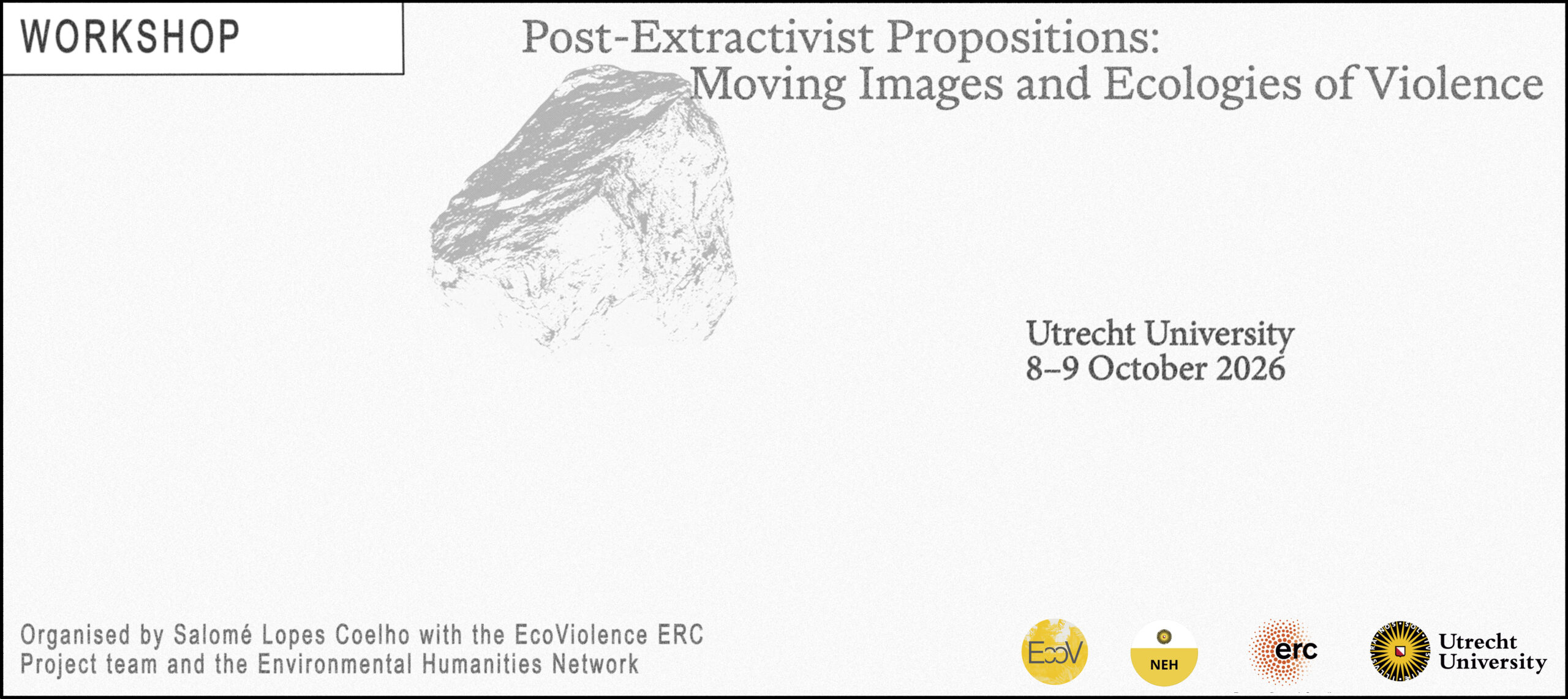
Call for Papers – Post-Extractivist Propositions: Moving Images and Ecologies of Violence
8–9 October 2026
This workshop -curated and led by Salomé Lopes Coelho– brings together scholars, artist-researchers, and filmmakers to explore how moving images reveal and challenge extractivism while experimenting with post-extractivist propositions. Here, post-extractivism is conceived as both a horizon and a framework: a set of critical and creative approaches that envision socio-ecological relations beyond extractive regimes. We focus on non-fiction practices -including collaborative, observational, investigative, and experimental documentaries and essay films- and how they render the logics, infrastructures, temporalities, and affective dimensions of extraction visible while tracing resistance and imagining forms of life and organisation beyond extractivism.
Context
Originating in Latin American thought, the notion of extractivism describes a historical regime organising relations between humans, territories, and more-than-human existences through large-scale removal and export of raw materials -minerals, timber, agroindustry- for the world market (Gudynas 2009, 2010). Developed to name the region’s insertion into global capitalism, extractivism drove imperial expansion, funded enslavement and territorial destruction, and extinguished diverse ways of earth relations, thereby producing the very foundations of capitalist modernity (Acosta 2012; Machado Araóz 2012). In recent decades, neo-extractivism has consolidated this logic under progressive governance: state-promoted resource extraction funding social programmes through neoliberal commodity circuits (Svampa 2019).
Contemporary scholarship extends the notion of extractivism beyond the exploitation of raw materials and labour to encompass data mining, the expansion of new green extractive frontiers tied to energy transition agendas, and the intensified extraction of “strategic minerals” driven by militarisation and geopolitical competition (e.g. Dunlap 2020; Riofrancos 2025). Across its historical and contemporary forms, extractivism affects ecosystems, labour, and social reproduction, and operates materially, perceptually and representationally, rendering territories and relational ecologies extractible while obscuring sustaining worlds (Gómez-Barris 2017). The concept also encompasses mentalities and self-reinforcing practices, from depletion and non-reciprocity to systemic violence, that normalise socio-ecologically destructive modes of life (Chagnon et al. 2022), as well as epistemic and ontological extractivism (Grosfoguel 2016, Riquito 2025). Such understandings allow us to trace extractivism’s economic, affective, and perceptual circuits, situating extraction within broader ecologies of violence in which historical, colonial, environmental, and militarised harms intersect through cultural and media representations (Knittel 2023).
These configurations have been confronted by critical, political, and territorial resistance, with Indigenous peoples and communities beyond urban cores leading efforts, seeking to dismantle extractive rationalities and reconfigure socio-ecological relations. Emerging from these struggles, post-extractivist critiques constitute analytical, aesthetic, and political practices that expose and resist the instrumental logic that strips non-human and relational worlds of intrinsic, cultural, or spiritual value (Fornoff 2023). In the humanities, this framework has inspired image-making and analyses of visual arts and moving images that render extractivist operations perceptible (e.g., Figueroa 2022; Jacobson 2025; Merchant 2025; Galindo 2025) while experimenting with post-extractivist possibilities envisioning decommodification of nature, commons-based economies, and alternative indices of well-being (Masek 2025).
Yet moving images, from production to reception, depend on materials, technologies, and labour embedded in extractive circuits, while simultaneously offering sensorial, essayistic, and speculative forms that render these circuits perceptible and contestable. Recent non-fiction -from collaborative documentaries and experimental works to investigative essay films and Indigenous film production-, exposes the colonial, ecological, and affective dimensions of extraction, foregrounding territories and communities confronting extractive frontiers. They operate as both material practices and visual systems, shaping perception (e.g., Bozak 2012, Parikka 2015) and constructing the cultural memory of extractive landscapes, while opening aesthetic and political spaces for contestation and post-extractivist imagination.
Workshop dynamics
Situated within these critical debates and moving image practices, this workshop foregrounds approaches from environmental humanities, media and film studies, cultural memory studies and decolonial, feminist, and queer scholarship, and invites contributions that engage moving images as sites of aesthetic experimentation, critical reflection, and political intervention. We welcome proposals that address the material, ethical, and epistemological enmeshments of cinema with extractive ecologies and that articulate post-extractivist modes of seeing, sensing, and organising life.
Possible topics
- Non-fiction articulations of extractive practices -mining, drilling, agribusiness, water extraction, logistics, and related infrastructures
- Post-extractivist propositions in non-fiction image-making, programming, and analysis
- Indigenous, feminist, queer, and decolonial forms of resistance in hybrid, essayistic, and investigative cinema
- Moving images and the cultural memory of extractive violence, including the reworking of established repertoires and tropes from other histories of violence to render extractivism perceptible
- More-than-human perspectives, ecologies, and agencies in moving image work
- Relations between moving images, activism, and community-based territorial struggles
- Data, algorithmic, and green extractivism across digital, renewable, and planetary frontiers
- The extractive material histories of moving image production, distribution, and reception
- Methodological experimentation in non-fiction, hybrid, and essayistic cinema, including approaches that critically reflect on the ethics and politics of mediation in extractive contexts
Format of the workshop
The workshop brings together scholars and moving image practitioners to share works in progress -academic papers and creative research- with the goal of fostering exchange and preparing contributions for a forthcoming peer-reviewed special issue. Participants are asked to circulate their materials (texts or multimodal formats) in advance, to enable in-depth collective discussion during the workshop. Alongside paper sessions, hands-on activities will engage with moving image creation within the environmental humanities.
Terms of submission
Please send proposals including title, abstract (250–300 words) for a 20-minute presentation, and a short bio (max. 150 words) to s.lopescoelho[@]uu.nl and ecoviolence[@]uu.nl by
15 May 2026. Notifications will be sent by 30 May 2026. Full papers are expected to circulate among participants by 30 August 2026.
Participation is free of charge. Limited travel support is available for early-career researchers, artist-researchers, students, and practitioners from affected territories or without institutional support. Please indicate whether travel support is required when submitting your proposal.
References
- Acosta, Alberto. 2012. Extractivismo y neoextractivismo: Dos caras de la misma maldición. Quito: Abya Yala.
- Bozak, Nadia. 2012. The Cinematic Footprint: Lights, Camera, Natural Resources. Rutgers University Press.
- Chagnon, Christopher W., Francesco Durante, Barry K. Gills, Sophia E. Hagolani-Albov, Saana Hokkanen, Sohvi M. J. Kangasluoma, Heidi Konttinen, et al. 2022. “From Extractivism to Global Extractivism: The Evolution of an Organizing Concept.” The Journal of Peasant Studies 49 (4): 760–792.
- Dunlap, Alexander. 2020. Renewing Destruction: Wind Energy Development, Conflict and Resistance in a Latin American Context. Rowman & Littlefield.
- Figueroa, Sebastián. 2022. “Apuntes sobre cine y extractivismo.” laFuga 26.
- Fornoff, Carolyn. 2023. “Extractivism.” In Handbook of Latin American Environmental Aesthetics, edited by Jens Andermann, Gabriel Giorgi, and Victoria Saramago, 45–66. De Gruyter.
- Galindo, Barbara. 2025. “Visualising Lithium Extraction as the Decapitation of Mother Salt in Cartier and Longo’s En el nombre del litio (2021).” Bulletin of Latin American Research 44: 248–262.
- Gómez-Barris, Macarena. 2017. The Extractive Zone: Social Ecologies and Decolonial Perspectives. Duke University Press.
- Grosfoguel, Ramón. 2016. “Del ‘extractivismo económico’ al ‘extractivismo epistémico’ y ‘extractivismo ontológico’: una forma destructiva de conocer, ser y estar en el mundo.” Tabula Rasa 24: 123–143.
- Gudynas, Eduardo. 2009. “Diez tesis urgentes sobre el nuevo extractivismo. Contextos y demandas bajo el progresismo sudamericano actual.” In Extractivismo, política y sociedad, edited by Eduardo Gudynas et al., 187–225. Centro Andino de Acción Popular (CAAP) and CLAES (Centro Latinoamericano de Ecología Social).
- Gudynas, Eduardo. 2010. “The New Extractivism of the 21st Century: Ten Urgent Theses about Extractivism in Relation to Current South American Progressivism.” Americas Program Report. Center for International Policy.
- Jacobson, Brian. 2025. The Cinema of Extractions: Film Materials and Their Forms. Columbia University Press.
- Knittel, Susanne. 2023. “Ecologies of Violence: Cultural Memory (Studies) and the Genocide–Ecocide Nexus.” Memory Studies 16 (6): 1563–1578.
- Machado Araóz, Horacio. 2012. Potosí, el origen. Genealogía de la minería contemporánea. Editorial Abya-Yala.
- Masek, Vaclav. n.d. “Post-extractivism.” Environmental Humanities: Emergent Key Terms. https://artsandculturalstudies.ku.dk/research/art-and-earth/environmental-humanities-glossary/post-extractivism
- Merchant, Paul. 2025. “Lithium and the Cinematic Temporalities of Argentina’s Energy Transition.” Environmental Humanities 17 (1): 268–279.
- Parikka, Jussi. 2015. A Geology of Media. University of Minnesota Press.
- Riofrancos, Thea. 2025. Extraction: The Frontiers of Green Capitalism. Icon.
- Riquito, Mariana. 2025. “‘Barroso Is Not to Be Sold, It Is to Be Loved and Defended’: Affective Mobilizations for Land and Life in the Context of Green Extractivism.” Capitalism Nature Socialism 36 (4): 27–51.
- Svampa, Maristella. 2019. Neo-extractivism in Latin America: Socio-environmental Conflicts, the Territorial Turn, and New Political Narratives. Elements in Politics and Society in Latin America. Cambridge: Cambridge University Press.
This workshop is part of the year-long programme Moving [Images] Post-Extractivism, curated and led by Salomé Lopes Coelho
www.ecologiesofviolence.utrecht.org, @eco_violence