Events
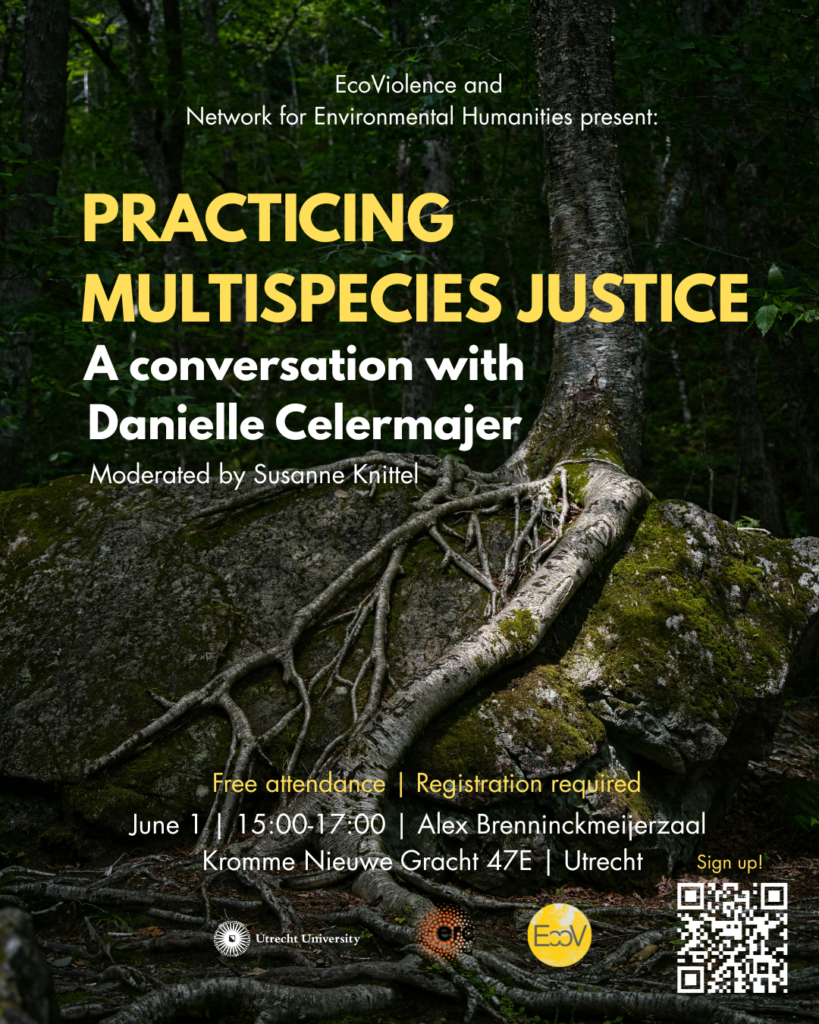
Practicing Multispecies Justice. A conversation with Danielle Celermajer
As the climate crisis deepens alongside accelerating biodiversity loss and ecological breakdown, conventional frameworks of justice—focused primarily on human interests—are increasingly called into question. Multispecies justice responds to this challenge by asking how we might recognise the entangled lives, vulnerabilities, and claims of humans, animals, plants, and ecosystems alike. Danielle Celermajer has been a central figure in shaping both the theory and practice of multispecies justice, and we are delighted to welcome her to Utrecht.
In this moderated conversation, we will explore multispecies justice as a project oriented not only toward addressing injustice and preventing harm, but toward enabling flourishing: what would it mean to create communities, institutions, and infrastructures in which diverse forms of life can thrive? The discussion will also consider how multispecies justice differs from and intersects with related movements such as the rights of nature, and what it offers as a framework for rethinking representation. What would it mean for the more-than-human world to be represented more equitably—within law and politics, but also in art, culture, and narrative? Bringing philosophical inquiry into dialogue with questions of governance, aesthetics, and creative practice, we want to explore how multispecies justice might reshape both our institutions and our imaginaries.
About Danielle Celermajer
Danielle Celermajer is Professor of Sociology and Criminology at the University of Sydney. She is the Deputy Director of the Sydney Environment Institute, where she leads the Multispecies Justice project. Her work is situated at the intersection of environmental justice, animal ethics, and political theory, and is widely recognised for advancing multispecies justice as a framework for responding to the climate crisis and mass extinction.
Her recent research focuses on how human-centred institutions contribute to ecological harm, and how they might be transformed to support the flourishing of more-than-human life. Bridging conceptual innovation with practical application, she has played a leading role in developing multispecies justice as both an analytical framework and an emerging set of practices for responding to planetary crisis.
This event is co-organized by the EcoViolence ERC project and the Utrecht Network for Environmental Humanities.
All are welcome! The event is free, but please register via this link.