
How can moving images reveal and refuse the ecologies of extractive violence? How can cinema enact post‑extractive world configurations?
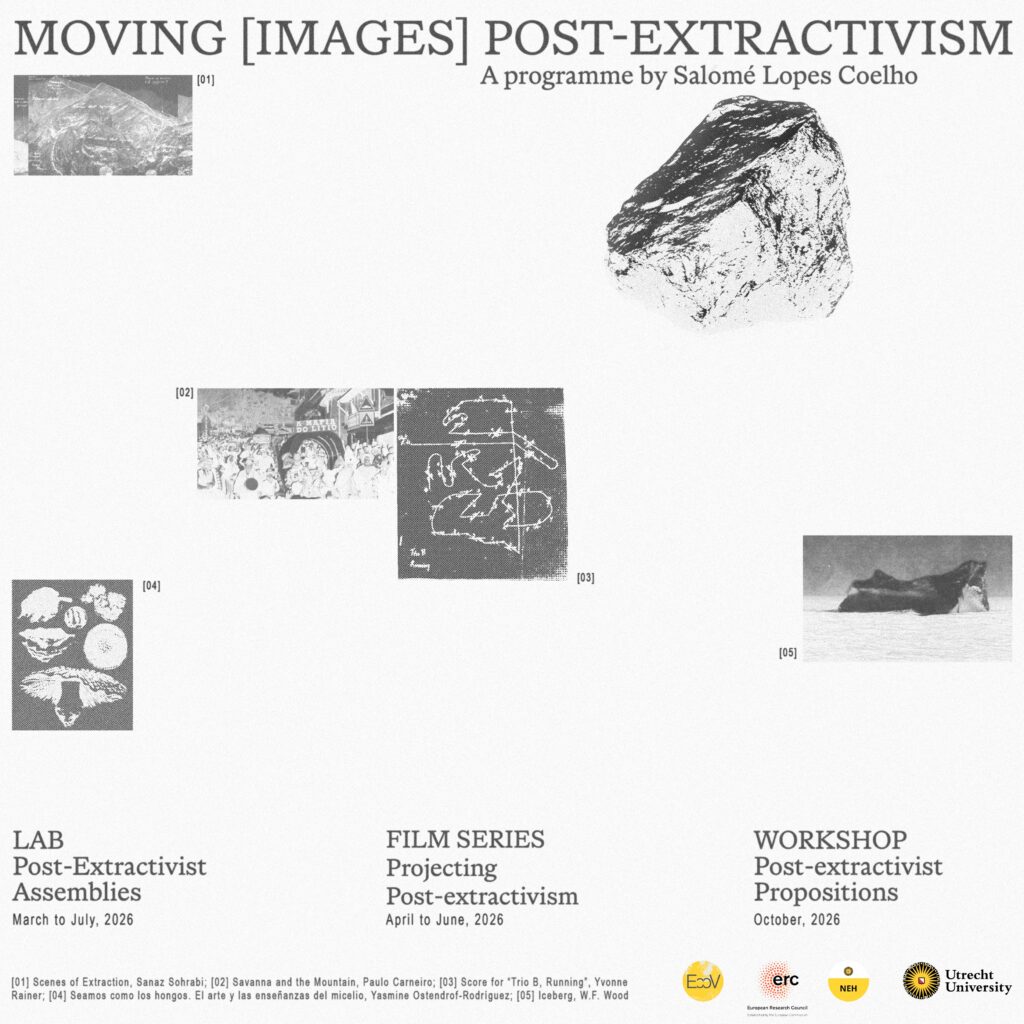
MOVING [IMAGES] POST-EXTRACTIVISM is a year-long programme that focuses on moving images to think with and against contemporary regimes of extraction, seeking ways of living and organising that move beyond the continual devastation of territories and communities for the sake of so-called resources and development.
Curated and organised by Salomé Lopes Coelho.
The programme has three pillars:
LAB
Post-Extractive Assemblies
Monthly sessions aiming to create a collaborative space at the intersection of practices of theory and artistic practices. Participants are invited to bring “ongoing projects” —including archival fragments, short videos, photographs, texts, or concepts—centered on ecologies of violence, extractivism, and post-extractivist thought.
Film Series
Projecting Post-Extractivism
Long entangled with visual complexes of European colonial modernity, cinema has shaped what can be made visible and sayable about worlds, their human and other-than-human inhabitants, and their relationships – mapping, measuring, and mediating territories to be surveyed and used, tearing beings from the relationalities that constitute them.
Read more
Yet it can also unsettle this way of seeing, insisting on the continuities extraction seeks to sever.
This screening series brings together collaborative documentaries and essay films that, through formal and sensorial experimentation, hold cinema accountable for its complicities while affirming it as a territory of inquiry and political-affective resistance to extractive violence. Working with archives, Indigenous worldviews, and situated struggles, these films trace extractivism as a visual and colonial capitalist regime – from green extractivism in Portugal, to early industrial and oil corporate archives in Iran, and to contemporary illegal mining violence in Yanomami territories in Amazonia – enacting, through cinema, worlds and ways of being, feeling, and knowing that colonial modernity has rendered expendable or extractible. Central to the series are cinema’s own capacities, in which formal and aesthetic choices are integral to opening post-extractivist world-configurations — rendering extractive violence perceptible while affectively and collectively composing alternatives.
Upcoming screenings
More info soon!
Previous screenings
-
28 May 2026
Post-Extractive Assemblies Lab: Lands – Memory – Waters
-
26 May 2026
II. Film screening ‘Scenes of Extraction’
-
16 Apr 2026
I. Film screening ‘Savanna and the Mountain’
Workshop
Post-Extractivist Propositions: Moving Images and Ecologies of Violence
8 – 9 October. This workshop brings together scholars, artist-researchers, and filmmakers to explore how moving images reveal and challenge extractivism while experimenting with post-extractivist propositions. Here, post-extractivism is conceived as both a horizon and a framework: a set of critical and creative approaches that envision socio-ecological relations beyond extractive regimes. We focus on non-fiction practices -including collaborative, observational, investigative, and experimental documentaries and essay films- and how they render the logics, infrastructures, temporalities, and affective dimensions of extraction visible while tracing resistance and imagining forms of life and organisation beyond extractivism.
Made possible by the support of European Research Council and Network for Environmental Humanities.
Graphic design: Ana Robles Pérez