
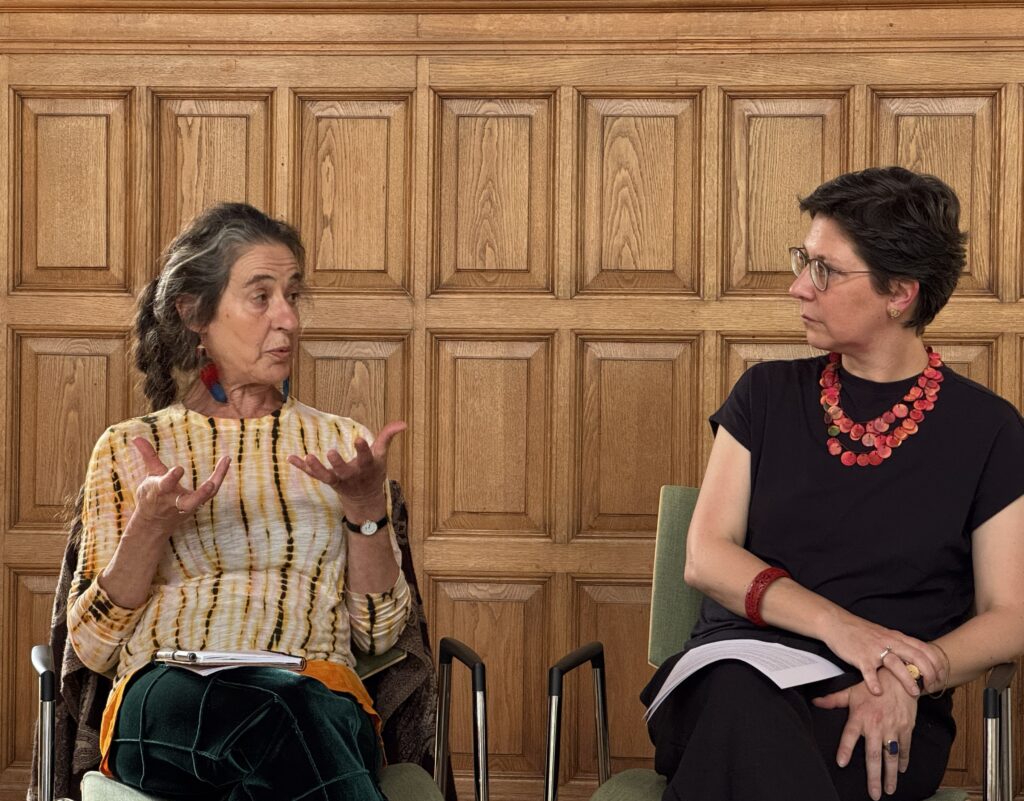
On June 1, EcoViolence and the Utrecht Network for Environmental Humanities hosted a conversation with Danielle Celermajer, moderated by Susanne Knittel, on how to conceptualize and enact justice in a more-than-human world.
The discussion began from a shared recognition: dominant frameworks of justice—historically centred on human subjects, harms, and rights—are no longer adequate to the scale and complexity of planetary crisis. Drawing on her earlier work on human rights and violence, Celermajer traced how an “ecological approach” to responsibility—one that foregrounds relationality over individual blame—opens onto the broader terrain of multispecies justice. This shift entails not only expanding the circle of moral concern, but rethinking the very conceptual architecture through which harm, responsibility, and repair are understood.
This shift is not only conceptual but also grounded in lived practice. Celermajer spoke powerfully about her own experience of living in a multispecies community, where humans, animals, and ecological processes are understood as co-constitutive rather than hierarchically ordered. Such an environment serves as an ongoing site of experimentation and learning, foregrounding the everyday negotiations, attentiveness, and ethical responsiveness required to live with, rather than simply alongside, other forms of life. It is in these situated practices that the abstract commitments of multispecies justice take on concrete form.
A key focus of the conversation was the problem of representation. What would it mean for the more-than-human world to be represented – not metaphorically, but materially – within our legal, political, and cultural frameworks? And where do existing models fall short? Rather than simply extending human categories (such as rights) to nonhuman entities, multispecies justice asks how forms of representation themselves might be rethought. This includes attending to the epistemic and aesthetic dimensions of representation: how ways of seeing, classifying, and narrating shape what—and who—can appear as a subject of justice.
In this context, artistic practices emerge as vital sites for experimenting with alternative modes of representation. Celermajer discussed several works that have been inspiring her, including Mourning the Great Barrier Reef by Anohni and the Johnsons, which stages ecological grief as a collective, affective response to environmental loss. The installation Birdsong (2006) by Janet Laurence—comprising rows of preserved bird skins from the Australian Museum—was discussed as a powerful meditation on taxonomy, extinction, and the forms of violence embedded in practices of collection and display. She also discussed Anselm Kiefer’s new exhibition Nymphaeum, which interweaves myth and materiality. In particular his monumental paintings of trees evoke deep temporalities and entangled histories of life, matter, and destruction, foregrounding the more-than-human as both witness to and archive of ecological devastation.
The second part of the event consisted of a presentation by artist Elmo Vermijs, whose work operates at the intersection of art, ecology, and spatial practice, and often takes the form of participatory installations that stage encounters between humans, landscapes, and the natural world. Vermijs’ current project, Amelisweerd: Towards Multispecies Justice, extends this line of inquiry through a transdisciplinary research-creation approach. Using the contested landscape of Amelisweerd near Utrecht as a case study, the project brings together artists, researchers from UU, legal scholars, Indigenous thinkers, activists, and local communities to develop the concept of the multispecies assembly. Rather than presuming that more-than-human perspectives can be straightforwardly “included,” the project explores how practices of deliberation, attention, and cohabitation might be reconfigured to make space for different forms of life, agency, and expression.
The event concluded with a discussion with the audience, which returned to the broader question of what it means to practice multispecies justice—not only as a theoretical framework, but as an ongoing, situated effort to rethink coexistence in a time of ecological crisis.